What Are the Hidden Costs of Buying Property in Panama?
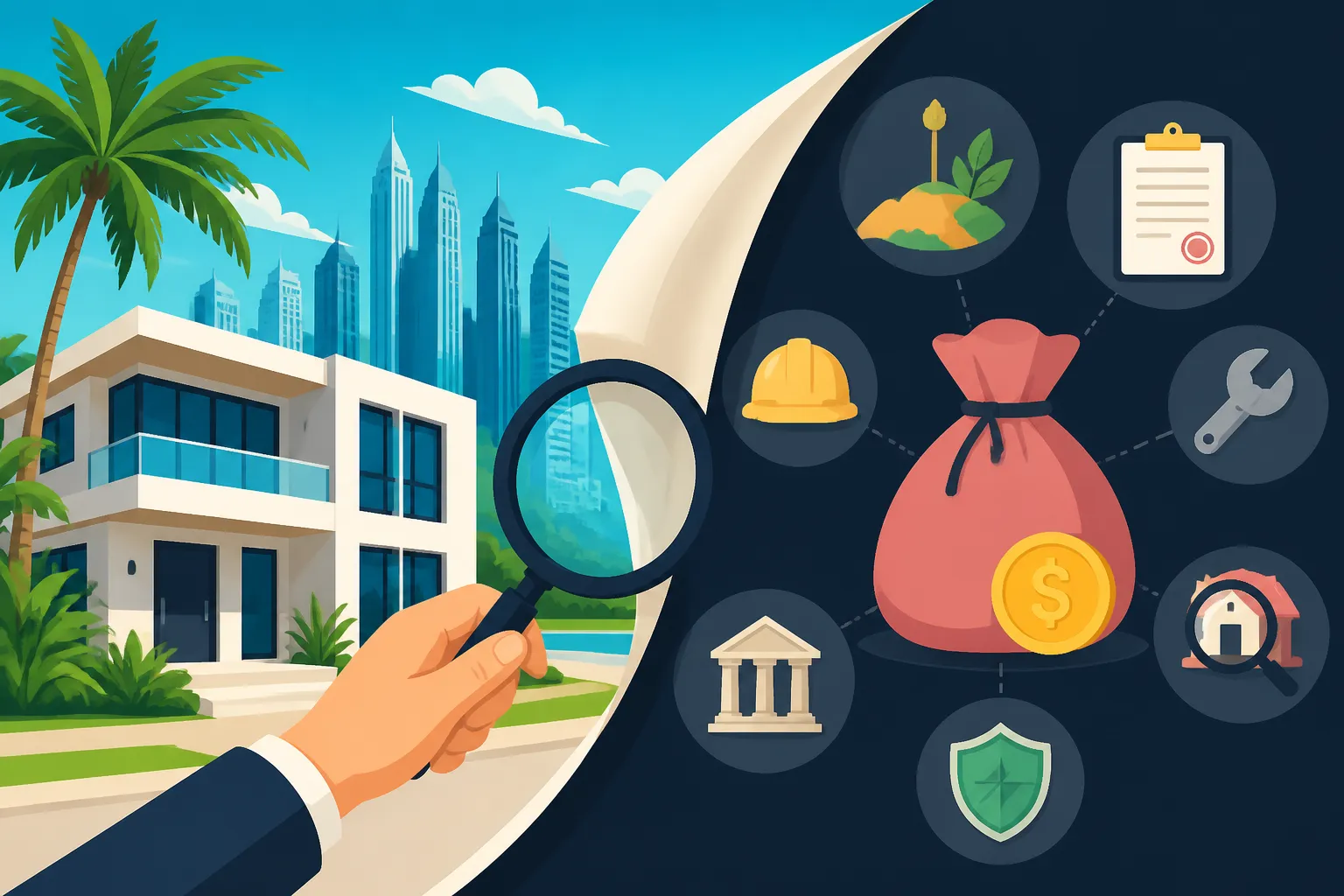
The dream of owning a piece of paradise in Panama, whether it's a sleek condo in Panama City with ocean views or a serene plot of land in the Chiriquí highlands, is incredibly alluring. You spend hours browsing listings, imagining your new life, and fixating on that headline price tag. But trust me, as someone who's navigated the exciting yet often bewildering world of Panamanian real estate, that advertised price is just the beginning. This guide is here to shed light on all those "hidden" costs that sneak up on you, ensuring your Panamanian property dream doesn't transform into a financial headache.
Initial Investments: The Costs Before You Even Say "Yes"
Before you even get to the closing table, there are several crucial costs that savvy expats need to factor into their budget. These are the expenses related to due diligence, legal protection, and the professionals who help you find your perfect spot. Skipping these can lead to far greater costs down the road, so consider them essential investments, not optional extras.
Legal Due Diligence and Representation Fees
This is, hands down, one of the most vital investments you'll make. The Panamanian legal system, while robust, operates differently from what many foreigners are used to. You absolutely must have a reputable Panamanian lawyer representing your interests, not just facilitating the transaction. Their role goes far beyond simple paperwork; they are your safeguard against potential issues.
Your lawyer will conduct thorough due diligence, which involves verifying the property title in the Public Registry, ensuring there are no liens, encumbrances, or outstanding debts associated with the property. They'll confirm that the seller is the legal owner and has the right to sell. They’ll also check for any pending lawsuits, zoning restrictions, or environmental concerns that could impact your ownership or future plans for the property. Imagine buying a beautiful beachfront lot only to discover later that a portion of it is protected mangrove forest and cannot be built on, or that a distant relative of the seller has a claim to a piece of it! Your lawyer unearths these potential landmines before you commit. Expect legal fees to range anywhere from 0.5% to 2% of the purchase price, depending on the complexity of the transaction and the lawyer's reputation. Don’t pinch pennies here; a good lawyer is worth their weight in gold. For more insight into the legal framework, you might want to read our guide on how to navigate the specific rules for foreign buyers in Panama in "What Are the Rules for Foreigners Buying Property in Panama?".
Real Estate Agent or Broker Commissions
While common practice in many countries dictates that the seller pays the real estate agent's commission, it's always good to understand this cost, as it's built into the property's price. In Panama, agent commissions typically range from 3% to 5% of the sales price, and sometimes even higher for raw land or very complex sales. This cost, while usually not directly paid by the buyer, contributes to the overall market price you're paying.
It’s worth noting that if you hire an agent specifically to find you a property, they might also charge a separate buyer's commission, though this is less common for standard residential purchases. Always clarify commission structures upfront with any agent you work with. A skilled agent can be an invaluable asset, especially when you're just starting to explore the market and need help understanding the nuances of different areas, from the bustling districts of Panama City to the tranquil coffee farms of Boquete. Finding a reliable agent is key, and our article "How Do I Find a Reliable Real Estate Agent in Panama" offers some excellent pointers. They can help you sift through options and even assist with initial price negotiations.
Appraisal and Survey Costs
Before you finalize your purchase, especially if you're seeking financing or if the property has unclear boundaries, an appraisal and a survey are crucial. An appraisal, usually costing between $300 and $1,000, provides an independent valuation of the property. This is particularly important for banks if you're applying for a mortgage, as they'll base their loan amount on this valuation, not just the sales price. A land survey, costing anywhere from $500 to several thousand dollars depending on the property's size and location, accurately delineates the property boundaries and confirms its exact dimensions. This is absolutely critical in Panama, where boundary disputes can arise, especially with older properties or rural land. You don't want to discover after the fact that the fence isn't where you thought it was, or that a portion of the beautiful garden you loved actually belongs to your neighbor.
Sealing the Deal: Navigating Panama's Closing Costs
Once you've agreed on a price and completed your due diligence, you'll enter the phase of closing the deal. This is where a significant chunk of the "hidden" costs typically appear, often surprising buyers who weren't prepared. These are the mandatory government taxes, registration fees, and notary expenses that formalize your ownership.
Property Transfer Tax (Impuesto de Transferencia de Bienes Inmuebles)
This is one of the biggest costs you'll face at closing. The property transfer tax in Panama is 2% of the higher value between the registered sales price and the property's cadastral value (the value recorded by the government's land authority). While legally this tax is the seller's responsibility, it's very common practice for it to be negotiated and often split between buyer and seller, or even fully absorbed by the buyer, especially in a seller's market or for particularly desirable properties.
For instance, if you're buying a property for $250,000 and the cadastral value is $200,000, the 2% tax will be calculated on $250,000, amounting to $5,000. It's crucial to clarify who is responsible for this during negotiations. Your lawyer will ensure this is properly accounted for and paid to the Direccion General de Ingresos (DGI) before the property title can be transferred to your name. We delve much deeper into this in our detailed guide, "Understanding the Property Transfer Tax When Buying in Panama."
Notary Fees (Gastos Notariales)
In Panama, all real estate transactions must be formalized through a public deed (escritura pública) before a Notary Public. The Notary’s role is to ensure the legality of the transaction, authenticate the signatures of all parties, and oversee the proper execution of the sales contract. Their fees are typically calculated on a sliding scale based on the property’s value.
For example, a property valued at $150,000 might incur notary fees of around $700-$1,000, while a $500,000 property could see fees closer to $2,500-$3,500. These fees generally cover the preparation and execution of the public deed. Just like with the transfer tax, it's often a point of negotiation whether the buyer or seller pays these, or if they are split. However, it's frequently the buyer who covers this expense.
Public Registry Fees (Registro Público)
After the public deed is signed at the Notary, it must be inscribed in the Public Registry (Registro Público) to legally transfer ownership. This is the final step that makes your ownership official and publicly recorded. The Public Registry fees are also calculated on a sliding scale based on the property's value, similar to notary fees but generally slightly lower.
These fees ensure that your ownership is recorded and protected by Panamanian law. Without this step, your ownership isn't fully secured. Think of it like this: the notary oversees the formal agreement, but the Public Registry is where that agreement becomes an undeniable legal fact for the world to see. It’s part of the bureaucratic journey you must undertake when becoming a property owner here.
Here's a quick overview of typical closing costs:
| Cost Type | Typical Percentage/Range (of purchase price) | Responsible Party (Typical) | Notes |
|---|---|---|---|
| Legal Fees | 0.5% – 2% | Buyer | Essential for due diligence and protection |
| Real Estate Commission | 3% – 5% | Seller (built into price) | May be shared or buyer-paid if using a buyer's agent |
| Appraisal | $300 – $1,000 (fixed fee) | Buyer | Often required for mortgages |
| Survey | $500 – $5,000+ (fixed fee) | Buyer | Highly recommended for clear boundaries, especially for land |
| Property Transfer Tax | 2% | Seller (often negotiated) | Calculated on higher of sales price or cadastral value |
| Notary Fees | 0.2% – 0.7% | Buyer (often negotiated) | For drafting and executing the public deed |
| Public Registry Fees | 0.1% – 0.3% | Buyer | For inscribing the deed and transferring title legally |
| Total Estimated Closing Costs | ~3% – 7% (excluding agent commission) | Varies | This is a general estimate; always get detailed quotes from your lawyer. |
The Ongoing Reality: Post-Purchase Property Expenses
Congratulations, you're officially a property owner in Panama! But the financial journey doesn't end when the ink dries on the public deed. There are ongoing costs that you need to budget for regularly, which can significantly impact your monthly or annual expenses.
Annual Property Tax (Impuesto de Inmueble)
Panama has an annual property tax, known as Impuesto de Inmueble or IBI, which is paid to the DGI. The amount you pay depends on the registered value of your property and the current tax rates. For residential properties, there are often exemptions or lower rates for primary residences, and sometimes for new constructions for a certain number of years.
As an expat, understanding these nuances is crucial. For example, properties valued under $120,000 might be exempt from property tax if they are your primary residence. For values above this, the rates are progressive, usually starting around 0.5% and increasing for higher values. For properties not designated as a primary residence (e.g., investment properties or second homes), the rates are generally higher, starting from 0.6% on values over $30,000. It's imperative to know the registered value of your property and clarify its tax status with your lawyer to avoid unexpected bills. Our comprehensive article on "Understanding Property Tax (IBI) for Homeowners in Panama" provides an in-depth look at these rates and exemptions.
Homeowners Association (HOA) / Propiedad Horizontal (PH) Fees
If you buy an apartment or a home within a gated community or a building with shared amenities, you will almost certainly be subject to HOA or Propiedad Horizontal (PH) fees. These fees cover the maintenance of common areas, security, elevators, swimming pools, gyms, building insurance, and sometimes even water and gas for your unit.
These fees can range wildly, from a modest $50-$100 per month for a smaller, older building to several hundred or even over $1,000 per month for luxury high-rise condos with extensive amenities in areas like Costa del Este or Punta Pacífica. It's absolutely critical to find out the current HOA fees before you make an offer, as they are a non-negotiable, recurring expense that can significantly impact your monthly budget. Beyond the regular fees, be aware that HOAs can also levy special assessments for major repairs or upgrades, such as a new roof or a significant refurbishment project. Always ask for the HOA's financial statements and meeting minutes to get a clear picture of their financial health and any planned large expenditures. Our article on "Understanding HOA and PH (Propiedad Horizontal) Fees in Panama" can give you a lot more detail.
Utilities and Services
Once you move in, you’ll be responsible for setting up and paying for your utilities. While these aren't "hidden" as such, the costs might differ from what you're used to, and the process of setting them up can be a bureaucratic headache for newcomers. This includes electricity, water, internet, and sometimes gas.
- Electricity: Depending on your usage, especially air conditioning in warmer areas like Panama City, electricity bills can be substantial. Panama has a tropical climate, and many expats are accustomed to cooler temperatures, leading to higher AC usage.
- Water: Generally quite affordable, especially compared to other countries.
- Internet and Cable TV: Several providers like Cable Onda (now Tigo) and Liberty offer packages. Costs vary based on speed and bundled services. Getting connected usually involves installation fees.
- Gas: Some buildings or homes use natural gas, which is usually quite economical.
The setup process often requires your cédula (Panamanian ID) or residency card, and sometimes a rental contract or property deed. This can be a challenge if you're fresh off the plane without all your documents in hand. Planning for these services and understanding their typical monthly costs is vital for your overall cost of living. For a full breakdown, check out "The Expat Guide to Setting Up Utilities (Electricity, Water, Internet) in Panama." If you’re waiting for your home internet to be set up, a service like Airalo can be a lifesaver for staying connected with an eSIM, ensuring you can still coordinate with utility companies or contractors from your phone.
Unforeseen Expenditures: The "Surprise" Costs That Add Up
Even with the best planning, there are always those unexpected expenses that crop up. These can range from minor annoyances to major budget busters, so it’s wise to keep a contingency fund specifically for these potential surprises.
Property Insurance (Seguro de Propiedad)
While not always mandatory, especially if you're paying cash, property insurance is highly recommended. If you're getting a mortgage in Panama, the bank will almost certainly require you to have fire and hazard insurance, at a minimum. Beyond that, consider additional coverage for natural disasters (Panama is in an earthquake zone, though major quakes are rare, and heavy rains can cause flooding), theft, and liability.
The cost of insurance varies based on the property’s value, location, and construction materials, but it’s an annual expense that can range from a few hundred dollars to over a thousand. It’s a small price to pay for peace of mind, especially when you’re in a new country and still learning the ropes. Don't skip this, thinking it's a way to save money; a single unforeseen event could wipe out your investment.
Financing Costs and Mortgage Fees
If you plan to secure a mortgage to finance your property purchase, you’ll encounter several additional costs. While it is possible for foreigners to get mortgages in Panama, the requirements can be stringent, and the process lengthy. Banks like Banco General or Banistmo are common choices, but be prepared for paperwork, income verification, and a higher down payment requirement than what locals might face.
Mortgage-related costs include:
- Loan Application Fees: Can be a few hundred dollars.
- Origination Fees: Sometimes a percentage of the loan amount.
- Bank Appraisal Fees: Similar to an independent appraisal, but specific to the bank's requirements.
- Mortgage Registration Fees: For recording the mortgage lien in the Public Registry.
- Life Insurance: Banks often require borrowers to take out life insurance that covers the loan amount.
- Interest: Of course, the ongoing interest payments are a significant factor.
These costs can easily add up to 1-3% of your loan amount, not including the interest. It’s a complex area, so make sure you read "How to Get a Mortgage to Buy Property in Panama" for a comprehensive understanding before you commit.
Moving and Relocation Expenses
While not strictly a "property purchase" cost, the act of buying a home is often intertwined with the cost of actually moving your life to Panama. This includes shipping your household goods, furniture, and personal belongings. Depending on where you’re coming from and how much you bring, this can be a very significant expense.
Costs involve packing, crating, sea freight or air freight, customs duties, and local transportation to your new home. These can easily run into thousands or even tens of thousands of dollars. Many expats choose to sell most of their possessions and start fresh, buying new items in Panama to save on these shipping costs. If you’re looking for international movers, companies listed on platforms like Sirelo can provide quotes and help you plan this often-overlooked logistical challenge. Don’t forget about the initial temporary accommodation costs while you wait for your new home to be ready or for your belongings to arrive.
Maintenance and Renovation Budget
Even if a property looks perfect on paper, once you move in, you’ll inevitably find things that need fixing, upgrading, or simply adapting to your preferences. The tropical climate in Panama can be tough on homes, leading to issues like mildew, rust, and pest control needs that might not be as prevalent in temperate zones.
It's always wise to budget for immediate minor repairs or renovations. Perhaps you want to repaint, upgrade an appliance, or install better security. These costs can quickly add up, especially if you're dealing with contractors who might charge a "gringo tax" if you're not careful. Always get multiple quotes, ask for references, and ideally, work with a trusted local who can help you navigate these projects. Even if your new home is in excellent condition, setting aside at least 1-2% of the property's value annually for maintenance is a smart move in Panama.
In summary, while Panama offers incredible opportunities for property ownership and a fantastic lifestyle, approaching the purchase with your eyes wide open about all the associated costs is key to a smooth and enjoyable transition. Do your homework, get good professional advice, and budget generously for the unexpected.
Disclaimer
The information provided in this article is for general informational purposes only and does not constitute legal, financial, or real estate advice. Property laws, tax regulations, and market conditions in Panama can change, and individual situations vary. It is strongly recommended to consult with qualified Panamanian legal professionals, real estate agents, tax advisors, and financial experts before making any property purchase decisions.