Understanding Capital Gains and Property Sale Tax in Panama
Selling property in Panama can feel like navigating a dense jungle, especially when it comes to understanding the taxes involved. Many expats find themselves scratching their heads, wondering if they'll be hit with a massive capital gains bill or if there's some secret loophole. This guide is here to shed light on Panama's capital gains and property sale taxes, breaking down exactly what you need to know to sell your property confidently and without unexpected financial surprises.
The Basics of Property Sale Tax in Panama: What Every Expat Needs to Know
When you decide to sell a piece of real estate in Panama, whether it's that charming beach house you poured your heart into or an investment condo in Panama City, there are generally two main taxes that come into play at the time of sale. These are the property transfer tax and, potentially, a capital gains tax. Understanding these from the get-go is absolutely crucial, because they're not always as straightforward as you might expect coming from another country.
Understanding the 2% Property Transfer Tax
Let's start with the one that's almost always a given: the 2% property transfer tax. This tax, formally known as Impuesto de Transferencia de Bien Inmueble, is a direct cost associated with transferring ownership of the property from the seller to the buyer. It's usually the seller's responsibility, and it’s calculated as 2% of the registered sale price or the property’s cadastral value (the value assigned by the government for tax purposes), whichever happens to be higher.
Now, this 2% might seem small on paper, but it can certainly add up, especially if you're selling a higher-value property. For instance, if you’re selling a home for $300,000, that’s $6,000 right off the top. The frustrating part for many is that this tax applies regardless of whether you made a profit or took a loss on the sale. It's simply a fee for the transaction itself. Imagine you bought a property during a boom, and now you're selling it during a quieter market, maybe even for less than you paid. You'd still owe that 2%. This is where many expats, used to systems where only profits are taxed, get a bit of a shock. It's just how the system works here, and it's a fixed cost you need to factor into your selling price from the start.
The 5% Capital Gains Tax – Or Is It?
This is where things can get a little more intricate and often lead to the most questions. Beyond the 2% transfer tax, Panama also has what's colloquially known as a capital gains tax on real estate sales. This tax is 5% and is applied to the net gain from the sale of the property. The net gain is essentially the difference between the property's adjusted purchase price (what you paid, plus approved improvements and adjusted for inflation) and the sale price.
So, if you bought a property for $100,000, spent $20,000 on legitimate, documented improvements, and then sold it for $150,000, your capital gain wouldn't be a simple $50,000. You'd factor in those improvements, and potentially an inflation adjustment, reducing your taxable gain. Let's say, after all those adjustments, your actual gain for tax purposes is $25,000. The 5% capital gains tax would then be 5% of that $25,000, which is $1,250. This seems reasonable, right?
The interesting and somewhat unique twist in Panama is that the seller typically has a choice between paying the 2% transfer tax or the 5% capital gains tax. You don't usually pay both on the same gain. This decision point is critical and can save or cost you a significant amount of money depending on your specific circumstances. We'll dive much deeper into this choice in the next section, but it's important to understand that while the 2% is a baseline for transfer, the 5% is the alternative specifically tied to your profit. For a broader understanding of how these property-related taxes fit into the larger picture, you might want to look into The Complete Guide to Property and Transaction Taxes in Panama (2027).
The Choice: 2% Transfer Tax vs. 5% Capital Gains Tax
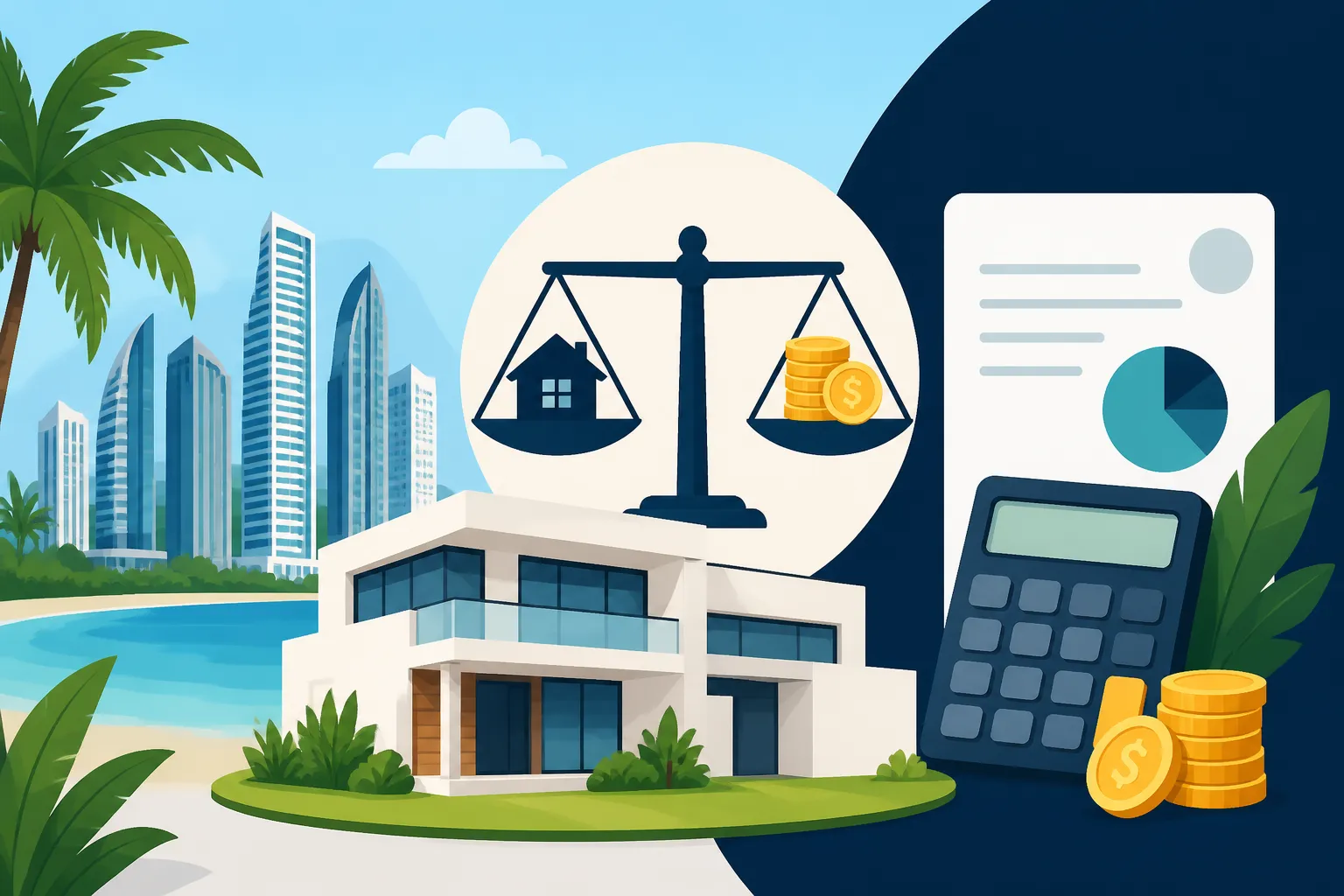
This is the part that often makes expats scratch their heads and wonder if they heard correctly. Unlike many other countries where capital gains on property are strictly calculated and applied, Panama offers a unique choice when it comes to the tax on your property sale. You generally have the option to pay either the 2% property transfer tax or the 5% capital gains tax. You don't pay both on the same portion of the transaction. Understanding this choice is paramount, as making the right decision can lead to considerable savings.
The "Impuesto de Ganancia de Capital" Dilemma
The "Impuesto de Ganancia de Capital" is the 5% tax levied on the actual profit you make from selling your property. The key word here is "profit." If you didn't make a profit, or if your adjusted costs (purchase price plus improvements) are very close to your sale price, then paying 5% on a small gain might be less than paying 2% on the total sale price.
Let's break down the dilemma with some hypothetical scenarios:
Scenario 1: You've made a significant profit.
- You bought a property for $150,000.
- You spent $20,000 on documented improvements.
- You sell it for $300,000.
- Let's assume, for simplicity, inflation adjustment makes your adjusted cost basis $180,000.
- Your taxable capital gain: $300,000 (sale price) – $180,000 (adjusted cost basis) = $120,000.
- 5% Capital Gains Tax: 5% of $120,000 = $6,000.
- 2% Property Transfer Tax: 2% of $300,000 (sale price) = $6,000.
In this specific example, the outcome is the same. However, the numbers often swing one way or another.
Scenario 2: You've made a modest profit, or sold quickly.
- You bought a property for $200,000.
- You spent $5,000 on documented improvements.
- You sell it for $220,000 after a short period, so inflation adjustment is minimal.
- Adjusted cost basis: $205,000.
- Your taxable capital gain: $220,000 – $205,000 = $15,000.
- 5% Capital Gains Tax: 5% of $15,000 = $750.
- 2% Property Transfer Tax: 2% of $220,000 (sale price) = $4,400.
In this scenario, clearly, choosing the 5% capital gains tax is vastly more beneficial, saving you thousands of dollars.
Scenario 3: You're selling at a loss or minimal gain.
- You bought a property for $250,000.
- You spent $10,000 on improvements.
- You sell it for $240,000.
- Adjusted cost basis: $260,000.
- Your taxable capital gain: You actually have a loss. In this case, there's no capital gain to tax.
- 5% Capital Gains Tax: $0 (since there's no gain).
- 2% Property Transfer Tax: 2% of $240,000 (sale price) = $4,800.
Here, choosing the 5% option (which results in $0 tax) is the undisputed winner.
This choice is one of the most important financial decisions you'll make during a property sale in Panama. It really underscores why having an experienced Panamanian lawyer or accountant is not just a good idea, but essential. They can help you calculate both scenarios accurately and advise you on the best path forward. Firms like Taxes for Expats often specialize in these intricate calculations, ensuring you navigate this dilemma efficiently.
Factors Influencing Your Decision
Several factors will heavily influence whether the 2% transfer tax or the 5% capital gains tax is more advantageous for you. It's not a one-size-fits-all situation, and each property sale needs individual analysis.
- Actual Profit Made on the Sale: This is the most significant factor. If your profit is low (or nonexistent), the 5% capital gains tax will almost certainly be the cheaper option, as 5% of a small number is less than 2% of a large sale price. If your profit is very high, you'll need to run the numbers carefully.
- Length of Ownership: The longer you've owned the property, the more likely it is to have appreciated significantly, but also the more likely that inflation adjustments will reduce your taxable gain for the 5% calculation. Panama's tax code allows for an inflation adjustment based on the official Consumer Price Index (CPI), which can slightly reduce your original purchase cost for the capital gains calculation, thereby reducing your taxable gain over time. This makes the 5% option potentially more appealing for properties held for many years.
- Deductible Expenses: This is where good record-keeping pays off in spades. For the 5% capital gains calculation, you can deduct legitimate expenses that increased the value of the property or were directly related to the acquisition. These include:
- Improvements and Renovations: Costs for major upgrades, additions, or significant renovations that enhance the property's value. You absolutely need invoices and receipts for these!
- Acquisition Costs: Notary fees, legal fees, and other legitimate costs incurred when you originally purchased the property.
- Real Estate Commission: The commission paid to the real estate agent for the sale of the property can often be deducted, reducing your net gain.
- Legal Fees for Sale: Your lawyer's fees for the current sale transaction are also typically deductible.
The more legitimate deductions you have, the lower your taxable capital gain will be, making the 5% option more attractive. This is why it’s critical to keep meticulous records from the day you buy your property until the day you sell it. Those crumpled receipts from five years ago might just save you a hefty sum! This really emphasizes the importance of understanding The Complete Guide to Taxes in Panama for Expats (2027) from the moment you arrive.
Calculating Your Capital Gains: Step-by-Step for Expats
Calculating capital gains in Panama isn't rocket science, but it does require careful attention to detail and, crucially, excellent record-keeping. As we've discussed, the goal is often to minimize your taxable gain to make the 5% option more appealing than the 2% transfer tax. This means accurately documenting your original purchase price and any subsequent investments you've made in the property.
Documenting Your Purchase Price and Improvements
The first and most fundamental step in calculating your capital gain is to establish your adjusted cost basis. This isn't just the price you paid; it's that price plus any legitimate expenses that added value or were necessary for the acquisition.
- Original Purchase Price: This is the base. You'll find this clearly stated in your original escritura pública (public deed) for the property. This document is your foundational proof of ownership and the initial investment.
- Documented Improvements: This is where many expats either shine or fall short. Any major renovations, additions, or significant upgrades that demonstrably increased the property's value can be added to your cost basis. Think a new roof, an added swimming pool, a major kitchen overhaul, or building an extension. What you can't generally include are routine maintenance costs like painting or minor repairs, as these don't typically increase the property's long-term value.
- Crucial Tip: You must have official invoices (facturas) for these improvements. Hand-written receipts or cash payments without proper documentation from a registered business simply won't cut it with the DGI (Dirección General de Ingresos), Panama's tax authority. Keep these invoices meticulously, ideally filed with your property deed.
- Acquisition Costs: Don't forget the costs you incurred when you bought the property. This often includes legal fees, notary fees, and registration fees. These legitimate expenses are part of your initial investment and can be added to your cost basis. Your original closing statement from your lawyer should list these.
Panama's tax law also allows for an inflation adjustment to your original purchase price (and eligible improvement costs). This is a pretty unique feature designed to account for the erosion of money's purchasing power over time. The DGI publishes an annual adjustment factor based on the Consumer Price Index (CPI). This factor is applied to your original purchase price (and improvement costs) for each full year you've owned the property, effectively increasing your cost basis and thereby reducing your calculated capital gain. For example, if you bought a property for $100,000 ten years ago, after inflation adjustment, your cost basis might be considered $115,000 for calculation purposes, even if you didn't add any improvements. This can significantly lower your taxable gain. If you want to dive deeper into official tax procedures, exploring Filing Your Tax Return with the DGI in Panama: The Complete Walkthrough (2027) could be very helpful.
The Calculation Process: An Illustrated Example
Let's walk through a detailed example to illustrate the capital gains calculation and compare it to the 2% transfer tax.
Hypothetical Property Sale:
- Original Purchase Price (2018): $250,000
- Documented Improvements (2021): $30,000 (new kitchen, bathroom renovation, with invoices)
- Sale Price (2026): $350,000
- Real Estate Commission (7% of sale price): $24,500
- Legal Fees for Sale: $1,500
- Inflation Adjustment Factor (approximate, for illustration based on 8 years ownership): Let's assume a total factor that increases original cost by 15% over 8 years.
Step 1: Calculate Adjusted Purchase Price (Original Cost Basis + Inflation)
- Original Purchase Price: $250,000
- Inflation Adjustment (15% of $250,000): $37,500
- Adjusted Original Cost: $250,000 + $37,500 = $287,500
Step 2: Calculate Total Adjusted Cost Basis (Adjusted Purchase Price + Improvements + Sale Costs)
- Adjusted Original Cost: $287,500
- Documented Improvements: $30,000
- Real Estate Commission: $24,500
- Legal Fees for Sale: $1,500
- Total Adjusted Cost Basis: $287,500 + $30,000 + $24,500 + $1,500 = $343,500
Step 3: Calculate Capital Gain
- Sale Price: $350,000
- Total Adjusted Cost Basis: $343,500
- Capital Gain: $350,000 – $343,500 = $6,500
Step 4: Calculate 5% Capital Gains Tax
- 5% of Capital Gain ($6,500): 0.05 * $6,500 = $325
Step 5: Calculate 2% Property Transfer Tax
- 2% of Sale Price ($350,000): 0.02 * $350,000 = $7,000
In this illustrative example, the 5% capital gains tax is $325, while the 2% property transfer tax would be $7,000. The choice is clearly to pay the $325. This shows how crucial it is to properly document all your expenses and leverage the inflation adjustment. Without those deductions and adjustments, your capital gain would be much higher, potentially making the 5% option less favorable.
Here's a comparison table:
| Calculation Aspect | 2% Property Transfer Tax | 5% Capital Gains Tax |
|---|---|---|
| Basis of Calculation | Sale Price | Capital Gain (Sale Price – Adjusted Cost Basis) |
| Example Sale Price | $350,000 | $350,000 |
| Example Adjusted Cost Basis | N/A | $343,500 (Purchase + Improvements + Costs + Inflation Adj.) |
| Taxable Amount | $350,000 | $6,500 (Capital Gain) |
| Tax Rate | 2% | 5% |
| Total Tax Due | $7,000 | $325 |
| Advantageous Option | 5% Capital Gains Tax (in this example, saving $6,675) |
As you can see, understanding these calculations and having all your ducks in a row with documentation can significantly impact your bottom line. It's a prime example of why getting professional advice from a local accountant or tax specialist is invaluable. They can guide you through the process, especially when it comes to nuances like the official inflation adjustment factors from the DGI.
Navigating the Payment and Filing Process
Once you've done all the calculations and decided which tax option is best for your property sale, the next step is actually paying the tax and ensuring all the necessary filings are completed. This part of the process is often handled through third parties and involves specific Panamanian institutions. It’s not something you typically do yourself by walking into a government office with a check, so understanding the flow is important.
Who Pays and When: The Notary's Role
This is probably one of the most important pieces of information for expats selling property in Panama. The payment of the 2% property transfer tax (or the 5% capital gains tax, if chosen) is usually facilitated by the notary public at the time of closing. This means that the buyer typically withholds the required tax amount directly from the sale proceeds that would otherwise go to the seller. The buyer then, through the notary, pays this amount to the DGI (Panama’s tax authority).
Let's break that down:
- Agreement: You and the buyer agree on a sale price.
- Calculation: Your lawyer or accountant calculates both the 2% transfer tax and the 5% capital gains tax, and you decide which is more beneficial.
- Withholding: At the closing, when the money changes hands (usually through a bank transfer or certified check), the buyer’s funds will have the agreed tax amount withheld. This means the portion of the sale price destined for the tax will go directly to the DGI instead of to you, the seller.
- Notary’s Role: The notary public, who is responsible for legalizing the property transfer deed, oversees this withholding and ensures the payment is made to the DGI. They are a critical intermediary in this process, ensuring compliance before the property title can officially be transferred to the new owner.
- Paz y Salvo: Once the tax is paid, the DGI issues a Paz y Salvo, which is a tax clearance certificate. This document is absolutely essential because the Public Registry will not process the transfer of the property title from the seller to the buyer without it. This means delays in getting the Paz y Salvo can hold up the entire transfer, which nobody wants.
This system is designed to simplify tax collection and ensure compliance, but it also means that as the seller, you need to be fully aware of the amount that will be deducted from your proceeds. It’s not an expense you pay out-of-pocket after you receive all your money; it’s taken directly from the sale at the point of transfer. Therefore, it's vital to have these calculations clear with your lawyer and the buyer beforehand. Knowing how to deal with the DGI is crucial, so a review of How to Register with the DGI (Direccion General de Ingresos) in Panama can provide valuable context.
Ensuring Compliance: Tips for Expats
Navigating the Panamanian tax system as an expat can be tricky, but ensuring full compliance when selling property is paramount to avoid headaches, delays, and potential fines.
- Get Your RUC (Tax ID) in Order: If you don't already have one, you will need a RUC (Registro Único de Contribuyente), which is your Panamanian tax identification number. This is required for any tax-related transactions, including property sales. Your lawyer or accountant can assist you in obtaining this. You can find more detailed information on How to Get an RUC (Tax ID) as a Foreigner in Panama.
- Engage a Local Accountant/Lawyer: While the notary facilitates the payment, having your own dedicated Panamanian lawyer or, ideally, an accountant specializing in real estate transactions, is highly recommended. They can:
- Accurately calculate both the 2% and 5% options, factoring in all legitimate deductions and the inflation adjustment.
- Ensure all your documentation (invoices for improvements, original deed, etc.) is in order and acceptable to the DGI.
- Verify that the notary correctly processes the payment and obtains the Paz y Salvo in a timely manner.
- Represent your interests throughout the closing process, ensuring you're not overpaying or missing any crucial steps.
- Keep Meticulous Records: We've said it before, and we'll say it again: documentation is king. From your original purchase agreement and all associated fees to every single invoice for improvements, keep everything organized and accessible. Digital copies are great, but sometimes originals are requested.
- Plan for International Transfers: After the sale, you'll likely want to move your proceeds to another country. While Panama uses the US Dollar, facilitating international transfers can still involve fees and currency exchange considerations if your destination currency is different. Services like Wise (formerly TransferWise) can be a cost-effective way to send larger sums of money internationally with competitive exchange rates and transparent fees. Just remember to account for the time it takes for funds to clear and transfer. For more details on moving money, check out How to Transfer Money Into and Out of Panama as an Expat.
- Understand Your Tax Residency: Your tax residency status in Panama and your home country can impact how this capital gain is treated internationally. Panama operates on a territorial tax system, meaning it primarily taxes income generated within Panama. However, your home country might have different rules. A tax professional can help you navigate any potential double taxation issues, especially if your home country doesn't have a double taxation treaty with Panama that specifically covers capital gains on real estate. This is a complex area, and understanding How Panama's Tax System Works: Territorial Taxation Explained (2027) is essential.
Specific Scenarios and Exemptions
While the general rules for property sale and capital gains tax in Panama are fairly consistent, some specific scenarios and nuances might arise that expats often inquire about. It’s important to clarify these to ensure you’re fully prepared and not relying on assumptions from other countries’ tax systems.
Primary Residence Exemptions (or Lack Thereof)
In many countries, selling your primary residence comes with significant tax advantages, often including complete exemptions on capital gains up to a certain threshold. This is a common and often crucial benefit for homeowners. Naturally, many expats moving to Panama or selling their Panamanian home ask, "Is my primary home exempt from capital gains tax here?"
Unfortunately, the straightforward answer in Panama is generally no, not in the same way you might find in the U.S., Canada, or the UK. Panama's tax code does not offer a blanket exemption for the sale of a primary residence that completely bypasses the 2% property transfer tax or the 5% capital gains tax.
However, there are very limited, specific situations that might offer some relief, though they are not as broad as many foreigners expect:
- Property Tax Exemption: It's worth noting that if your property has a permanent improvement value (the value of the construction, not the land) below $120,000, it's generally exempt from annual property taxes. This is different from the sale taxes we're discussing, but it's a common point of confusion. For information on annual property taxes, you can read Understanding Property Tax (IBI) for Homeowners in Panama.
- Minimal Gain Scenarios: As discussed earlier, if your capital gain is very small, or you sell at a loss, choosing the 5% capital gains option effectively leads to little to no tax, which acts as a de facto "exemption" in practice for the gain itself, though the 2% transfer tax would still be paid on the gross value of the sale if you chose that route.
Ultimately, you should operate under the assumption that your primary residence sale will be subject to either the 2% transfer tax or the 5% capital gains tax, and plan accordingly. Don't assume an exemption unless a qualified Panamanian tax professional explicitly confirms it for your specific situation.
Impact of Residence Status and International Tax Treaties
Your personal residency status can add another layer of complexity to property sales. Panama operates on a territorial tax system, which means it primarily taxes income and gains sourced within its borders. This is fantastic news for many expats, as it generally means your foreign-sourced income (like a pension or investment income from outside Panama) is not taxed by the Panamanian government, regardless of your residency status here. You can explore Tax Residency in Panama: A Definitive Guide for Expats (2027) to understand this better.
When it comes to the sale of Panamanian property, the gain is considered Panama-sourced income. Therefore, the 2% transfer tax or 5% capital gains tax is applicable regardless of whether you are a Panamanian tax resident, a provisional resident, or even a non-resident selling property here. The tax is tied to the asset's location and the transaction taking place in Panama.
However, where your residency status does become a crucial factor is regarding your home country's tax obligations:
- Tax Residency in Your Home Country: Even if Panama doesn't tax your foreign income, your home country might still tax your worldwide income, including capital gains made in Panama. For example, a U.S. citizen is taxed on worldwide income, regardless of where they live. So, while you'll pay tax in Panama on the property sale, you might also have to report that gain to the IRS.
- Double Taxation Agreements (DTAs): Panama has Double Taxation Agreements with several countries (e.g., Mexico, Spain, Portugal, South Korea, UAE, UK, among others). These treaties are designed to prevent individuals and companies from being taxed twice on the same income or gain. If your home country has a DTA with Panama, it will typically outline how property gains are treated. Often, such treaties stipulate that gains from immovable property are taxable in the country where the property is located (i.e., Panama), and your home country might then provide a credit for the tax already paid in Panama. This avoids paying the full tax twice.
- Non-Residents Selling Property: If you are a non-resident of Panama and own property here, the same 2% or 5% tax rules apply at the time of sale. The mechanism remains the same: the tax is withheld by the buyer (via the notary) and paid to the DGI, and a Paz y Salvo is issued. You'll still need a RUC for this transaction. The key difference might be how your home country views a capital gain from a property in a country where you are not resident. Always consult with a tax advisor in both Panama and your home country to understand your full tax picture.
In conclusion, the Panamanian property sale taxes apply to everyone selling property in Panama, irrespective of their residency status. The impact of your residency status primarily lies in how this gain is treated by your home country's tax authorities, and whether a Double Taxation Agreement offers any relief. This is where personalized professional advice from an international tax specialist becomes indispensable, ensuring you comply with all regulations and minimize your global tax burden.
Disclaimer
The information provided in this guide is for general informational purposes only and does not constitute legal, financial, or tax advice. While we strive to keep the information up-to-date and accurate, tax laws and regulations in Panama can change, and individual circumstances vary widely. It is essential to consult with a qualified Panamanian attorney and a tax professional for advice tailored to your specific situation before making any decisions related to property sales or taxes in Panama. Relying solely on general information without professional consultation is done at your own risk.